
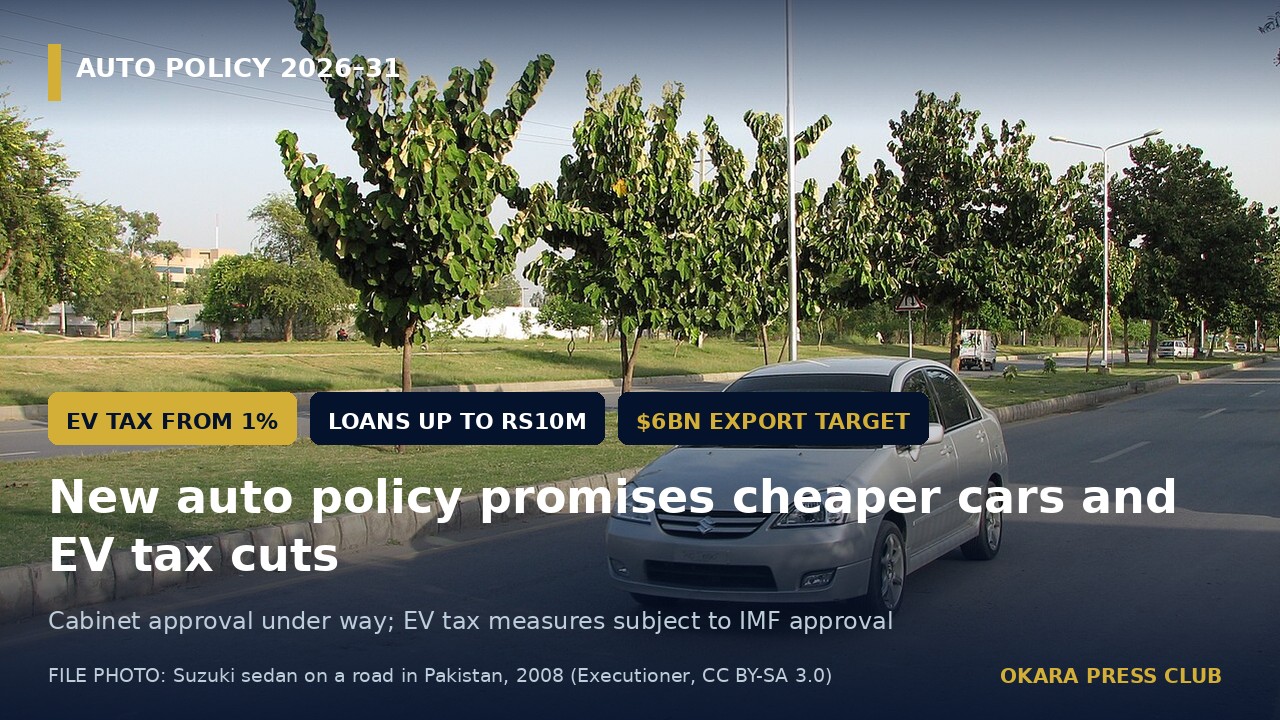
The federal government has unveiled a new auto policy for 2026-31 promising cheaper vehicles, a push towards electric cars and higher exports, with ministers saying prices will fall gradually over five years.
Information Minister Attaullah Tarar and the prime minister’s Adviser for Industries and Production, Haroon Akhtar Khan, announced the policy in Islamabad on Saturday as cabinet approval began.
The policy rests on six pillars: cheaper vehicles, especially for the middle and lower-middle classes; encouraging exports; localisation; vehicle safety; promotion of electric vehicles; and transparency.
Duties on completely built units, assembly kits and components will fall each year over five years, bringing tariffs to competitive levels. Mr Akhtar said prices of all vehicles except luxury models would come down as manufacturing costs fall. Advance payments at booking are capped at 20 per cent of the vehicle price, to end the on-money premium charged by dealers.
For electric vehicles, the government has proposed sales tax of 1 per cent on fully electric cars, 6 per cent on range-extended models and 9 per cent on plug-in hybrids. No capital value tax, withholding tax or federal excise duty would apply to electric vehicles up to $50,000; dearer models face normal taxation. The tax measures are subject to approval by the International Monetary Fund.
Financing for electric vehicles will also expand: the State Bank’s car financing limit will rise from Rs3 million to Rs10 million, with repayment extended from three years to five. Charging-station equipment gets 1 per cent sales tax and no customs duty. The government aims for 30 per cent of all new vehicle sales to be electric by 2030.
The policy sets a cumulative export target of $6 billion over five years, with a 5 per cent duty drawback for exporters, plus 10 per cent on incremental annual export growth; manufacturers missing export and localisation targets face penalties.
On safety, the policy adds 45 standards in line with the United Nations’ WP.29 code. Incentives will be funded by an automotive development levy on petrol and diesel vehicles above 1,000cc; smaller cars, used by many lower-income households, see no change.