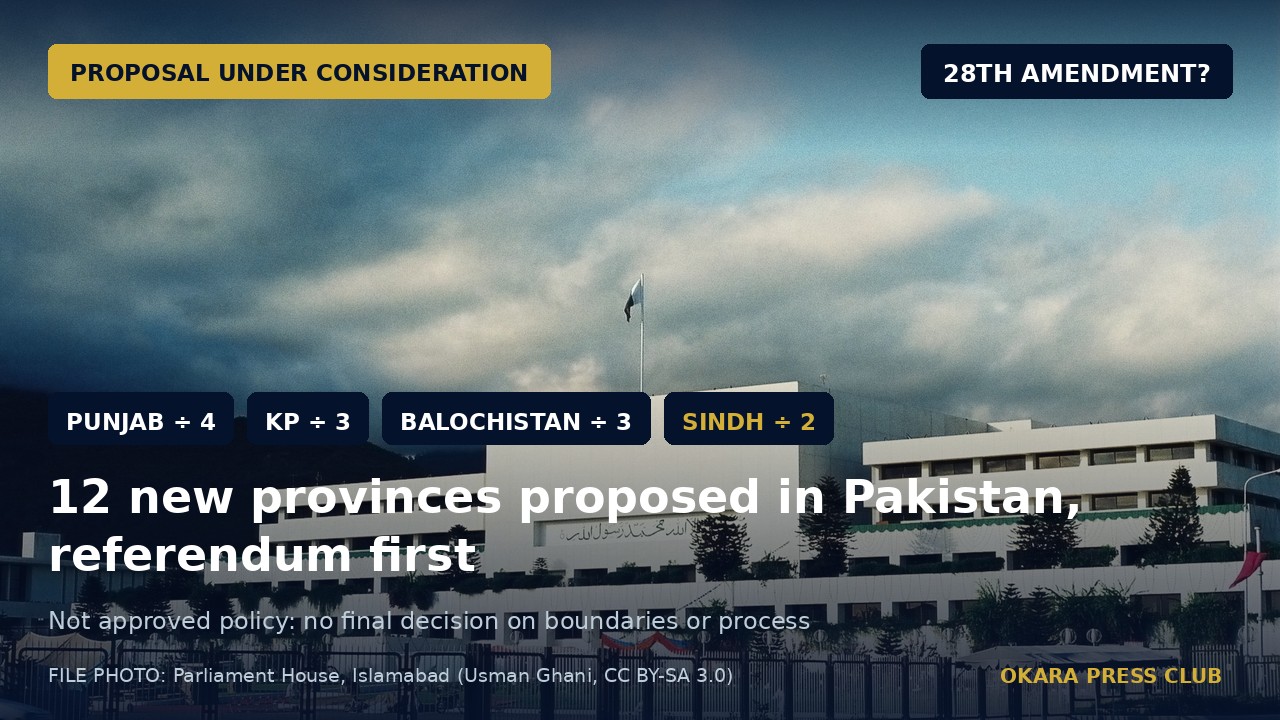
A proposal to redraw Pakistan’s administrative map into 12 provinces is under consideration, with a nationwide referendum envisaged before any move towards a possible 28th Constitutional Amendment, according to reports published on Sunday.
Under the arrangement described by sources familiar with the proposal, Punjab would be divided into four provinces, Khyber Pakhtunkhwa and Balochistan into three each, and Sindh into two. That would take the total number of provinces from four to 12.
The sources said preparatory steps could begin in the first quarter of 2027, with the amendment itself possibly taken up in the first half of the year. The referendum would come first, before the amendment process begins, to gauge public opinion and establish a popular mandate.
The idea is presented as an effort to improve governance, strengthen administrative efficiency and spread development and resources more evenly. Supporters argue smaller units would bring government closer to citizens and make it easier to spot local priorities.
The proposal remains strictly at the consideration stage. No final decision has been taken on boundaries, administrative structures or the constitutional process, and those questions would still need lengthy political and parliamentary discussion.
The latest report sits uneasily with the government’s own recent statements. Planning Minister Ahsan Iqbal said on 30 October that the government was not drafting a 28th Amendment to create new provinces, arguing instead for stronger local governments. Weeks earlier, on 4 September, he had called for a national debate and floated 12 to 15 provinces.
The prime minister’s Adviser on Political Affairs, Rana Sanaullah, has separately said any referendum would need Parliament’s approval, and that Parliament alone would decide whether provinces are created. An amendment needs two-thirds of the total membership of each house, and a change to a province’s boundaries also needs two-thirds of that provincial assembly under Article 239.
For now, the 12-province plan is a proposal under discussion, not approved policy and not a tabled amendment. It is also separate from earlier speculation around the 28th Amendment, including claims linking support for it to the release of former prime minister Imran Khan.