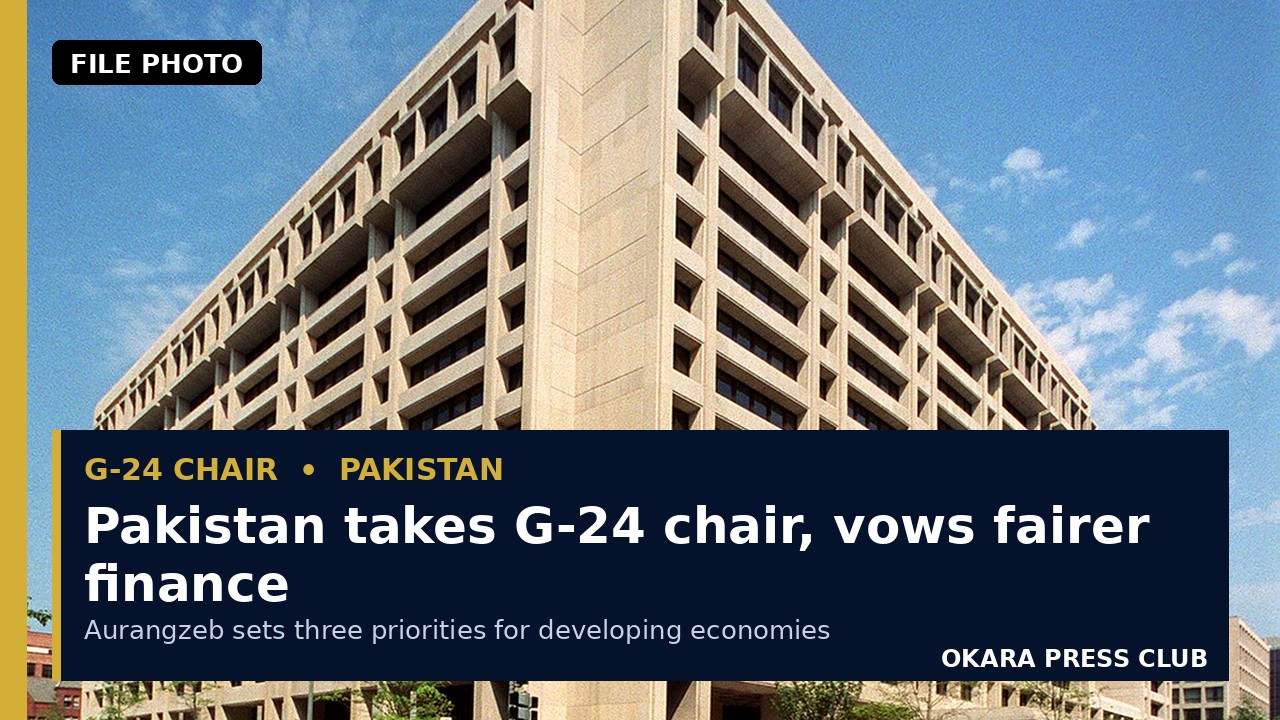
Pakistan assumed the chairmanship of the Intergovernmental Group of Twenty-Four (G-24) on Sunday, pledging to push for a fairer global financial system and a stronger voice for developing economies.
Finance Minister Muhammad Aurangzeb, who now chairs the group, described the role as a profound responsibility. In a statement issued by the Finance Ministry, he called for renewed international cooperation, stronger multilateral institutions and firmer global commitments to tackle climate shocks, development financing gaps and economic fragmentation.
Aurangzeb set out three priorities for Pakistan’s tenure. The first is to place development at the centre of global economic policymaking. The second is to strengthen the representation of developing economies inside multilateral institutions. The third is to advance a development-oriented international financial architecture, including fairer access to development finance and sustainable debt solutions.
Prime Minister Shehbaz Sharif and President Asif Ali Zardari welcomed the appointment on Monday, according to The Express Tribune. The prime minister said the chairmanship would give Pakistan an influential platform to argue for essential reforms in the global financial system, equitable climate finance and sustainable development opportunities for emerging economies, and he praised Aurangzeb and his team for their diplomacy.
The G-24, established in 1971, is a coalition of developing countries that coordinates their positions on international monetary and financial issues, particularly at the International Monetary Fund and the World Bank. Pakistan succeeds Nigeria as chair, and Aurangzeb acknowledged Nigeria’s leadership as outgoing chair, saying Pakistan would build on the group’s progress.
Pakistan’s chairmanship will be guided by the group’s longstanding principles of consultation, consensus and collective advocacy, the Finance Ministry said. Aurangzeb said Pakistan would work closely with members across Africa, Asia, Latin America and the Caribbean, alongside the IMF, the World Bank and other international partners, to turn shared priorities into practical outcomes.
The ministry also reaffirmed Pakistan’s commitment to strengthening the collective voice of developing economies and advancing what it called a more responsive, fair and development-oriented international financial system.