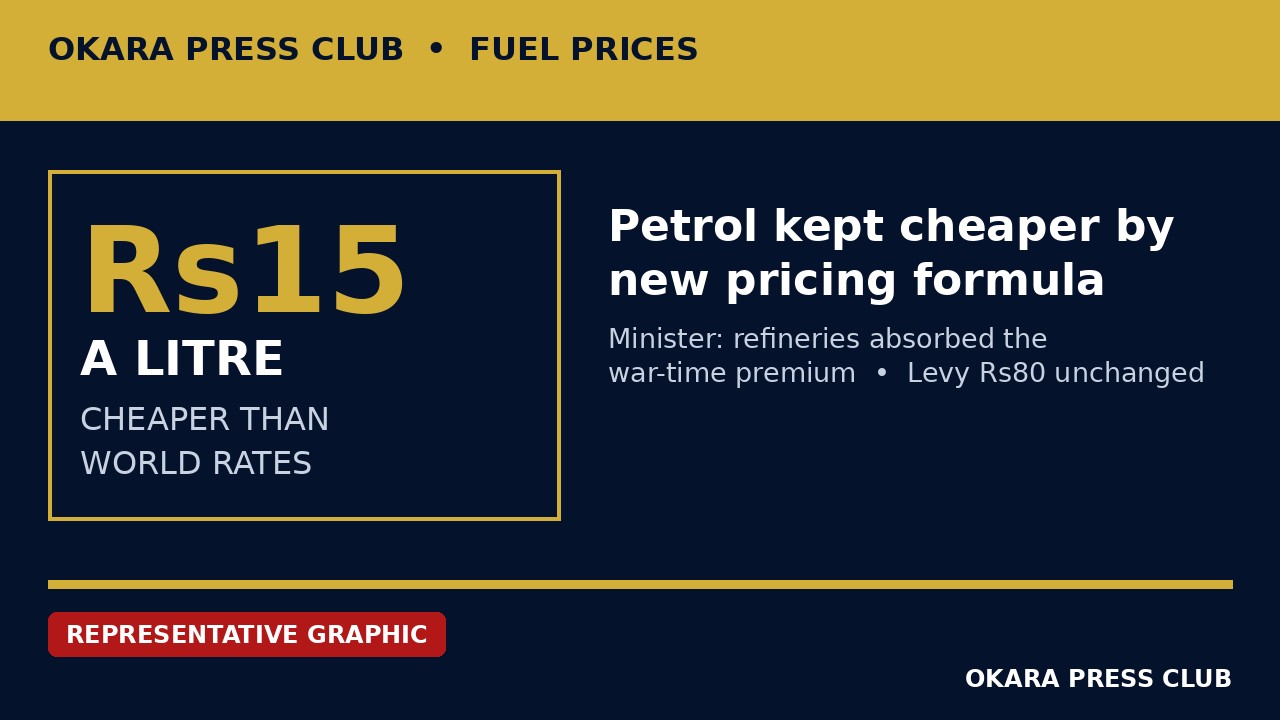
The government says a revised petrol pricing formula has kept petrol about Rs15 a litre cheaper than international market rates during the US-Iran war: cheaper than it would otherwise have cost, not a fresh Rs15 cut at the pump.
Petroleum Minister Ali Pervaiz Malik told a news conference in Islamabad on Monday that the petrol premium had jumped from about $5 a barrel before the war to about $20, with later Pakistan State Oil tenders reaching roughly $25 to $30 a barrel.
About 70 per cent of Pakistan’s petrol is imported and 30 per cent produced locally, Malik said, so any intervention had to avoid making imports unviable and risking shortages. He thanked refineries for absorbing a rise of roughly Rs15 a litre due on Friday, saying they carried a burden of about Rs15 billion a month.
The federal cabinet approved the revised mechanism on 30 October. Under it, the import price is now based on the actual cost of the relevant PSO cargo, or, if unavailable, on the last available cargo’s premium, charges and duty. For refineries, those three components are fixed at their 7 March pre-war levels for 30 days, and the difference between the import price and the resulting ex-refinery price is to be surrendered under the petroleum levy account, with the benefit passed on as a corresponding reduction in the petrol price. A smoothing adjustment also folds the premium-differential benefit into prices at $2.950 a barrel a day.
The existing petroleum levy of Rs80 a litre remains unchanged. Separate regulator correspondence put the surrender at Rs49.02 a litre, equal to Rs14.71 a litre against the levy, close to the minister’s rounded Rs15 figure.
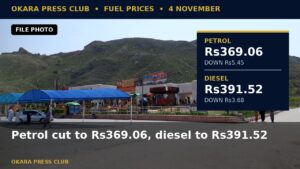
Under the most recent pump revision, petrol was held at Rs377.91 a litre. Information Minister Attaullah Tarar said there was no fuel shortage. Malik said November gas arrangements were in place, and he disputed reports that LPG prices had reached Rs700 a kilogram.
Malik added that international prices were now falling, raising hopes of further improvement. The formula applies only to petrol; other products are unchanged, and the refinery arrangement lasts 30 days.